
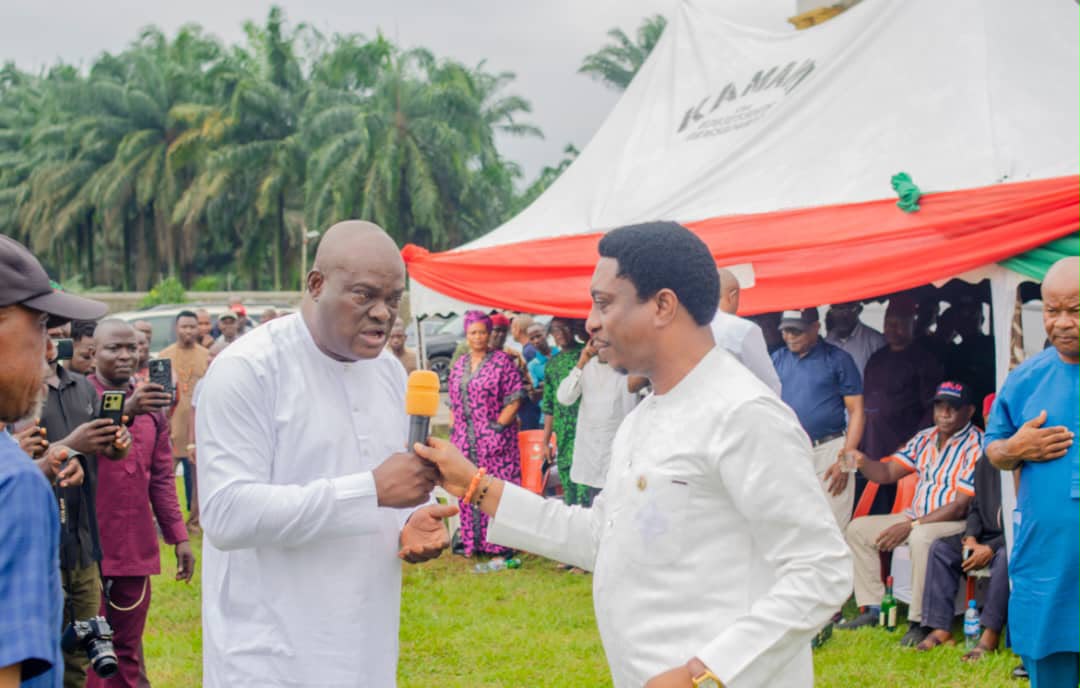

The recently concluded statewide thank-you tour undertaken by the governorship candidate of the Peoples Democratic Party (PDP) in Abia State, Dr Kelechi Anosike, offered more than an opportunity to express appreciation to party members. It became an early demonstration of the PDP’s grassroots strength, internal mobilisation and determination to reclaim the Abia governorship in the 2027 general election.
Following his decisive victory in the party’s governorship primary, Anosike embarked on a tour of the 17 local government areas of the state, meeting party leaders, stakeholders, candidates and grassroots members in their respective councils.
The tour was also the fulfilment of a commitment Anosike made during his consultations ahead of the primary. Having previously visited the 17 local government areas to seek the support of party members, he promised to return and thank them if entrusted with the party’s governorship ticket.
By returning shortly after his emergence, Anosike demonstrated an important quality that is often missing in Nigerian politics: the willingness to honour a promise after obtaining the desired political support. Rather than treat party leaders and members merely as instruments for securing the ticket, he returned to acknowledge their contributions and reinforce the relationships established during the nomination process.
From Ukwa East to Aba South, Obingwa, Ikwuano, Arochukwu, Umuahia North and the other local government areas, the tour provided Anosike with an opportunity to reconnect with party structures and begin the transition from being a primary-election aspirant to becoming the candidate and leader of a statewide governorship campaign.
The significance of the tour lay not only in the number of places visited, but also in the enthusiasm with which the candidate was received by party members. The gatherings brought together local government and ward executives, former political office holders, candidates, community leaders, women, youths and other stakeholders whose participation will be crucial to the PDP’s performance in 2027.
At several stops, the large turnouts, chants of solidarity and assurances from party leaders suggested that Anosike’s candidacy had gained acceptance among the party’s grassroots membership.
His visit to Obingwa, for instance, was marked by strong declarations of support from party members, with the candidate describing the local government area as one of the PDP’s strongest political bases in Abia State. The overwhelming outcome of the tour in Obingwa, reaffirmed the commitment of the party to work for the victory of the PDP and its flag bearers in the coming election.
Although described as a thank-you tour, the exercise effectively became the PDP’s first major post-primary mobilisation ahead of the 2027 governorship election.
It provided the party with an opportunity to assess its local structures, identify areas requiring reconciliation and reassure members who may have become discouraged following the party’s defeat in the 2023 governorship election.
The tour also allowed Anosike to establish direct contact with the people who will eventually drive the campaign at the ward, community and polling-unit levels.
It was a strategic effort to reactivate the PDP’s grassroots machinery across the 184 wards in the 17 local government areas and send a clear message that the party intends to approach the 2027 election as an organised political institution rather than depend solely on the popularity of individual candidates.
Anosike has repeatedly described the PDP as the most deeply rooted and structured political party in Abia, maintaining that it retains a presence across the wards and polling units of the state. During an earlier homecoming in Umuahia, he declared that the party had become stronger, more united and better positioned to compete for power in 2027.
The thank-you tour gave practical expression to that declaration.
Perhaps the most important political outcome of the tour was the apparent acceptance of Anosike by a broad section of the PDP membership.
Before the primary, questions had been raised in some quarters about his visibility and level of engagement within the party. However, his decisive primary victory and the receptions accorded him during the statewide tour have significantly altered that conversation.
The enthusiasm witnessed at the different stops suggested that many party members have moved beyond the contest for the governorship ticket and are increasingly prepared to rally behind the winner.
That transition is vital. Political parties often emerge from contentious primaries weakened by resentment, factionalism and defections. For the PDP in Abia to compete successfully against an incumbent government in 2027, it must prevent unresolved primary-election grievances from undermining its campaign.
Anosike’s decision to personally visit the local government areas, meet stakeholders and thank party members therefore represents an early attempt to build unity and collective ownership of the campaign.
His landslide primary victory gave him the ticket, but the thank-you tour appears to have begun the more important process of converting that victory into widespread acceptance within the party.
The message from many of the gatherings was clear: party members did not merely accept Anosike as the party’s candidate; they increasingly presented him as the political figure around whom the PDP could rebuild its governorship ambition.
The turnout also challenged suggestions that the PDP’s structures had completely collapsed after losing control of the state in 2023. The ability to convene leaders and members across the 17 local government areas remains an important indication that the party possesses an organisational foundation on which to build.
Anosike’s tour demonstrated that many of those networks remain active and could be fully reactivated ahead of 2027. Party leaders at the various stops expressed renewed optimism and pledged to work towards a successful outing in the general election.
The tour therefore served as a political confidence-building exercise. It reminded members that the PDP remains capable of rebuilding, reorganizing and competing for power despite the setback of 2023.
It also provided Anosike with an opportunity to urge members to put previous disagreements behind them and approach the election with unity, discipline and a shared sense of purpose.
For a party seeking to defeat an incumbent administration, enthusiasm alone will not be sufficient. It must be translated into sustained engagement with members and voters, effective ward-level organisation, credible messaging, trained polling-unit agents, election-day mobilisation and the protection of votes. Nevertheless, the enthusiasm generated by the tour offers the PDP an important starting point.
Another major feature of the tour was Anosike’s consistent emphasis on welfare, human-capital development and infrastructure.
His central argument is that physical infrastructure and human development should not be treated as competing priorities. According to him, a responsible government must build roads, schools, healthcare facilities and other public infrastructure while simultaneously improving the welfare, skills, productivity and economic security of the people.
That message resonated with party faithful because it addressed the immediate economic difficulties confronting workers, pensioners, traders, artisans, farmers, unemployed youths and vulnerable families.
Anosike, who has described himself as a welfarist, has outlined proposals that include improved remuneration for civil servants, strengthened healthcare services, expanded health-insurance coverage, pension reforms, youth skills development, agricultural expansion and job creation.
He has also proposed the establishment of programmes and agencies designed to enhance the capacity and economic value of Abia youths, develop skills for local and international employment, strengthen the informal sector and improve agricultural production.
Among the initiatives he discussed with party members were a comprehensive health-insurance programme, reforms for workers and pensioners, the construction of rural roads to support farmers, youth-employment programmes and an agricultural policy described as “Operation Feed Abia”.
The foundation of his message is that development must have a human face.
Anosike argued that roads, bridges and public buildings are important, but that their value is diminished when the citizens expected to use them are struggling with poverty, unemployment, poor healthcare and inadequate wages.
“Our government will build infrastructure and also build lives,” he declared while outlining his policy direction, insisting that infrastructural development must not come at the expense of citizens’ welfare.
This approach offers the PDP a potentially effective campaign narrative. Rather than oppose infrastructure development, the party can argue for a broader understanding of governance—one that combines visible physical projects with improved salaries, pensions, healthcare, education, employment opportunities, agricultural development and social protection.
That distinction is likely to become central to the 2027 governorship debate.
During the tour, Anosike and other PDP leaders criticised the administration of Governor Alex Otti, accusing it of giving insufficient attention to the welfare of workers, pensioners and ordinary citizens.
The PDP candidate has argued that governance should not be assessed solely by the number of roads constructed or the publicity generated around government projects. He maintains that the true test of development is the extent to which public policies improve the daily lives of the people.
The tour showed that the PDP still possesses substantial human and organisational assets across Abia State. It also suggested that Anosike is making progress in uniting party members and gaining acceptance beyond the delegates who voted for him during the primary.
Anosike insisted during the tour that, for the party to convert the momentum generated by the exercise into electoral success, it must strengthen its structures in all 184 wards, reconcile aggrieved members, attract undecided voters, present realistic policies and establish an effective campaign organisation extending to every polling unit.
Above all, the tour signalled that the PDP had begun preparing early for the 2027 contest.
The receptions accorded the candidate suggest that a growing number of party members have accepted his leadership and are ready to work with him. The gatherings also indicated that the disappointment of 2023 has not extinguished the PDP’s determination to rebuild, reorganize and return to power.
