
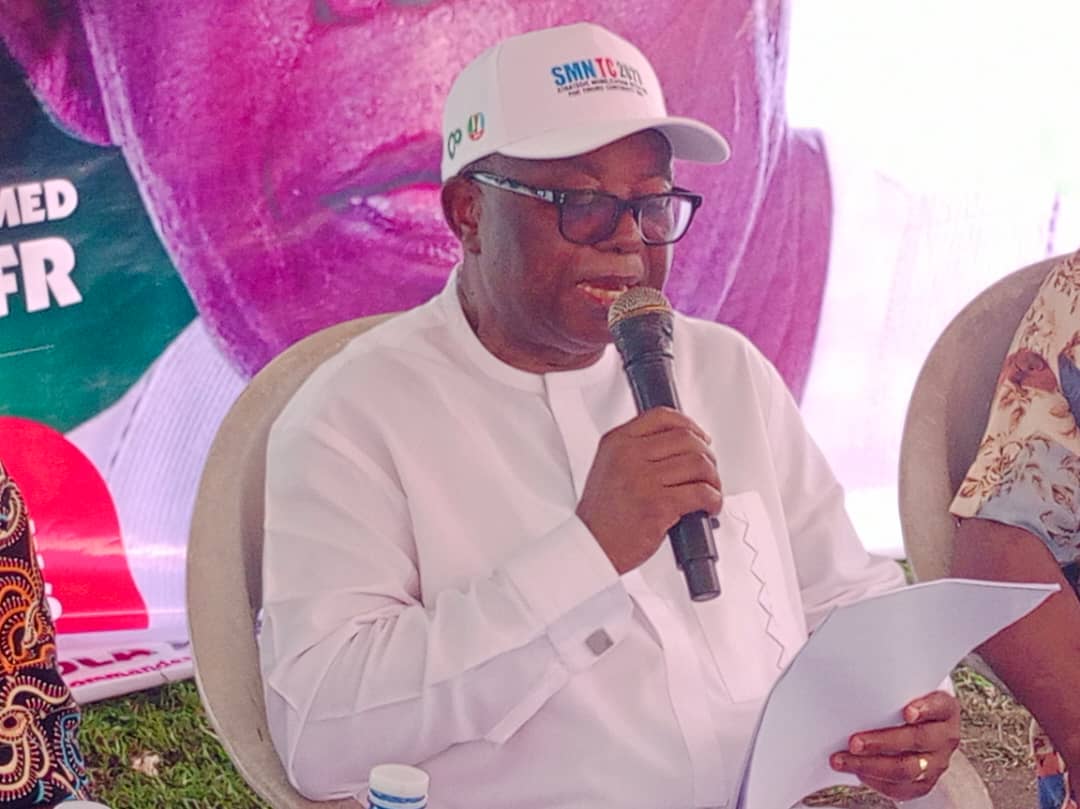

Former member of the House of Representatives, Rt. Hon. Sir Sam Onuigbo, has called on Nigerians to support the re-election of President Bola Ahmed Tinubu in 2027, arguing that the country needs policy continuity to consolidate ongoing economic reforms and complete major developmental projects.
Onuigbo, who is the President of Globe Legislators , during an interactive session in Umuahia, with members and stakeholders of the Strategic Mobilization Network for Tinubu Continuity 2027, called on Nigerians support massively the re-election of the President.
Speaking on the theme, “The Case for Continuity, Consolidation and Prosperity,” he said the Tinubu administration had initiated significant reforms and laid foundations for national development which should not be abandoned midway.
He explained that the Strategic Mobilization Network was established to build a formidable grassroots structure capable of taking the message of continuity beyond political meetings to markets, schools, workplaces, communities and religious institutions.

According to him, the network’s responsibility is to communicate the administration’s policies and achievements to Nigerians, while acknowledging existing challenges and engaging citizens respectfully.
Onuigbo identified the removal of fuel subsidy and unification of the foreign exchange market as major decisions taken by the Tinubu administration to address longstanding structural problems in the economy.
Although acknowledging that the reforms had imposed economic difficulties on households through increased transportation costs and food prices, he maintained that they were necessary to address distortions in the economy and redirect government resources towards critical sectors.
He cited the reported decline in headline inflation to 14.63 per cent in September 2026, from higher levels recorded previously, as evidence of improving economic conditions, while noting that the decline in inflation did not mean that prices had returned to their former levels.
The former lawmaker also highlighted Nigeria’s economic growth, stating that the economy expanded by 3.87 per cent in 2025, compared with 3.38 per cent in 2024, while recording 4.43 per cent growth in the second quarter of 2026.
He further cited the growth in the country’s foreign reserves, which he said reached approximately $55 billion in October 2026, describing it as an important development for strengthening investor confidence and supporting economic stability.
On the petroleum sector, Onuigbo said increased crude oil production and the emergence of the Dangote Refinery had created opportunities for Nigeria to reduce dependence on imported petroleum products, conserve foreign exchange and strengthen domestic industries.
He also identified the Presidential Initiative on Compressed Natural Gas and Electric Vehicles as part of the administration’s efforts to provide alternative transportation options and reduce energy costs.
Speaking on education, he commended the establishment of the Nigerian Education Loan Fund (NELFUND), saying the initiative had provided financial support to more than 1.64 million students, with over N372.62 billion disbursed in student loans.
He described the programme as an important intervention capable of improving access to tertiary education, particularly for students from financially disadvantaged backgrounds.
On infrastructure, the former lawmaker listed the Lagos-Calabar Coastal Highway and Sokoto-Badagry Superhighway among major projects requiring sustained government commitment to ensure their completion and economic benefits.
He also called for improved access to affordable credit for traders, artisans, small business owners and young entrepreneurs, stressing the need to ensure that government financing initiatives reached ordinary Nigerians.
On agriculture, Onuigbo acknowledged the persistent challenge of high food prices, calling for sustained investments in mechanisation, irrigation, improved seedlings, fertilisers, storage facilities and access to markets to boost food production and improve farmers’ incomes.
He further identified insecurity as a major national concern, advocating stronger security institutions and improved policing arrangements, including the proposed state police framework.
The former lawmaker, however, maintained that support for continuity should not be interpreted as a claim that everything was working perfectly, insisting that the administration must address its shortcomings and ensure that its policies translate into improved living conditions for Nigerians.
Turning to the responsibility of the mobilisation network, Onuigbo urged members to engage directly with different segments of society, including market women, students, professionals, artisans, traditional rulers, religious leaders and community organisations.
He advised members against relying solely on social media, urging them to embark on physical grassroots engagements and communicate the administration’s policies using verifiable facts rather than exaggerated claims or political insults.
According to him, the network must also establish measurable targets to assess the number of people reached, concerns raised and progress recorded in its mobilisation activities.
He said the organisation’s message should revolve around four key principles: continuity, consolidation, completion and prosperity.
“Continuity, to sustain the reforms and policies that are producing results; consolidation, to strengthen the gains and ensure that more Nigerians benefit; completion, to finish the projects and deliver the promises that remain outstanding; and enjoy the accompanying prosperity,” he stated.
Onuigbo urged members to leave the gathering with a renewed commitment to building an organised, disciplined and effective political mobilisation structure ahead of the 2027 general elections.
He said the ultimate objective was to persuade Nigerians that the country’s ongoing reforms and development initiatives deserved another opportunity to deliver their intended benefits.
“We are not asking Nigerians to believe that everything is perfect. We are asking them to believe that Nigeria’s progress is worth sustaining and that the work already started deserves to be completed,” he said.
Speaking further, a member of the Peoples Democratic Party (PDP), Board of Trustees representing Abia Central, Chief Tony Ezebiro, disclosed that discussions between the PDP and the All Progressives Congress (APC) had resulted in an agreement to support President Bola Tinubu’s second-term ambition.
Ezebiro attributed the development to what he described as the Federal Government’s favourable disposition towards PDP members, expressing confidence that the partnership would translate into massive electoral support for Tinubu.
On the impact of the Federal Government’s education intervention, a student of Ogbonnaya Onu Polytechnic, Aba, and beneficiary of the Nigerian Education Loan Fund (NELFUND), Mr Benhur Anyaocha, said the scheme had provided significant relief to students struggling with the financial demands of tertiary education.
He particularly acknowledged the provision of student loans and monthly upkeep allowances, noting that the initiative had eased financial pressures, reduced student protests and allowed beneficiaries to focus more on their academic pursuits.
Similarly, representatives of persons with disabilities and widows at the event applauded the Federal Government’s empowerment initiatives, saying the programmes had provided support that improved their economic circumstances.
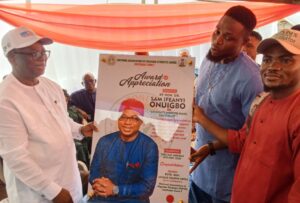
Meanwhile, the National Association of Nigerian Students (NANS), South-East Zone F, recognised Onuigbo’s contributions to student development with an Award of Appreciation, naming him Students’ Mentor, NANS South-East.
